Guidebooks have always been a good place to start when planning a holiday. The Lonely Planet Guidebooks are one of the first places that people go to find out information about travelling in countries throughout the world. Other useful series are Fodor's Travel Guides and DK Eyewitness Travel Guides.
Many of the Lonely Planet Guidebooks are now available as ebooks and can be purchased online and downloaded onto your electronic device. Some Lonely Planet titles may be available to borrow as ebooks from the library. Lonely Planet also produce Travel Apps for Apple devices. DK Eyewitness Travel Guides also publish some of their guides as ebooks and have produced Travel Apps which can be used to provide information when visiting a selection of cities.
Both Lonely Planet and Fodor's Travel provide online information which may be useful when planning a holiday.
You can explore the different sections as shown on the home page of the website or use the search box at the top of the screen to search for a country or city.
Highlights, Places, Things To Do, Hotels, Need to Know, Tips and Articles and Image Gallery are the main sections that can be investigated for the selected location.
The Need to Know section includes information about Health & Safety, Money & Costs, Visas, Getting Around, Getting There & Away, When To Go & Weather, Work and History.
If using Fodor's Travel website make a selection from the Destinations menu or use the search box at the top of the screen to search for a country or city.
Friday, June 13, 2014
Monday, June 9, 2014
Currency - exchange rates
One website providing information about currency and exchange rates is XE
The website provides live exchange rates.
There is also a currency converter.
Select the required currency for conversion and then click the arrow.
Click the Rates tab to view the latest exchange rates for the selected currency.
The website provides live exchange rates.
There is also a currency converter.
Select the required currency for conversion and then click the arrow.
Click the Rates tab to view the latest exchange rates for the selected currency.
World Weather Online
When planning a holiday it is often useful to know what the weather is likely to be like where you plan to visit. World Weather Online provides such information.
First select the Country you want to investigate from the alphabetical list of countries.
As we are travelling to France I selected the link for that country.
I then clicked the link for Lyon - one of the sites we are visiting. It is also possible to search by region. A detailed weather forecast for the next week is provided . There is also a summary of what the weather is like at different times of the year.
Our visit to France begins in Nice so I checked the weather for that city too.
Saturday, March 1, 2014
Launceston - Westbury Road
In the mornings we usually went for a walk along Westbury Road, Prospect, both for exercise and also to explore the area near the motel.
The street is on a hill and many new homes have been built, or will shortly be built on either side of the road, each vying for a view of the valley below. The Olde Tudor Shopping Complex contains a variety of shops including an IGA. There is also a smaller group of shops further down the hill. Dunn Stone Industries, stonemasons, process and sell granite, stone and marble products. Across the road is located the Mt Pleasant Laboratories.
From Westbury Road there are many opportunities to enjoy the view looking towards the river and the city of Launceston.

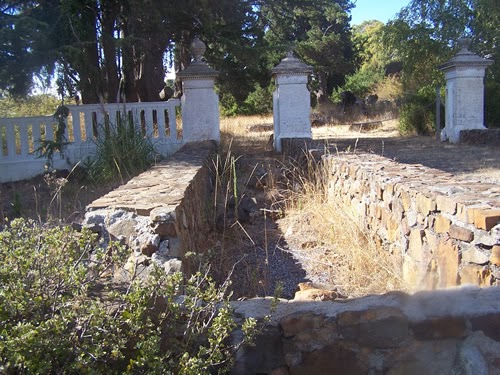
Out the back is a small brick building. Like the back of the house, walls of the building have been destroyed.
An impressive white fence is in front of the house. In front of the fence are rows of stones, closed at the section near the road but open near the fence.
I am sure that the house has a story to tell. It is also but one example of the many older buildings that can be discovered in Launceston. Fortunately most of the older buildings we saw in Launceston appear to be cared for and preserved. It is unlikely, however, that this building in Westbury Road will be around for much longer as it appears to have been left to fall down.
Exploring Launceston
Wednesday 26 February 2014 - Most members of the touring party spent Wednesday at the Launceston Cup but a small group of us decided to explore parts of Launceston instead.
The bus driver made a detour to drop us off near the start of Cascade Gorge before driving the rest of the Victorians to the race track.
Cataract Gorge is only a short work from the centre of Launceston.
Wednesday was a public holiday due to the running of the Launceston Cup so groups of school students were swimming in one section of the Gorge.
We had a pleasant stroll to the gardens and restaurant where we sat outside for about an hour, relaxing, having a drink, talking and being entertained by numerous peacocks and their young who were wandering between the tables and on the nearby lawn. Four of us decided to continue the walk across the suspension bridge to the other side of the Gorge.
The path for the next stage of the walk was closed so we walked past the park and swimming pool to the carpark where we organised a taxi back to Launceston.
Launceston was very quiet because of the public holiday and most of the shops were closed, however the absence of people in the streets made them easier to explore. After lunch we walked several blocks through the main shopping area to City Park as one of the group had been there earlier in the week as she wanted to show us the monkeys.
Macaque monkeys from Japan live in the park entertaining the many people who stop to view them. The monkeys were a gift from the people of Ikelda in Japan - a sister city of Launceston. A number of wallabies were sent to Japan as part of the exchange.
Near the monkey enclosure is the John Hart Conservatory with a colourful selection of plants. The conservatory was built with money from the John Hart Bequest in 1932 and was refurbished in 2010.
After leaving the park we passed the vertical retort house built in 1932 as part of the former gas works now partly used as a Hogs Breath Cafe.
Around the corner we found additional buildings belonging to the site including what would have been the administrative offices for Launceston Gas Company which started producing gas from coal around 1860. The vertical retort house and the gas tank can be seen in the background.
Further along the street we passed the Customs House, a most impressive looking building built in 1885 and demonstrating the importance of Launceston as a port at that time.
We followed along the banks of the North Esk River and then across a park until we reached the Tamar River.
The building in the distance is the silos which are clearly visible from many vantage points over the city.
We then returned back to the motel via taxi.
The bus driver made a detour to drop us off near the start of Cascade Gorge before driving the rest of the Victorians to the race track.
Cataract Gorge is only a short work from the centre of Launceston.
Wednesday was a public holiday due to the running of the Launceston Cup so groups of school students were swimming in one section of the Gorge.
![]() |
| Looking towards the suspension bridge |
The path for the next stage of the walk was closed so we walked past the park and swimming pool to the carpark where we organised a taxi back to Launceston.
Launceston was very quiet because of the public holiday and most of the shops were closed, however the absence of people in the streets made them easier to explore. After lunch we walked several blocks through the main shopping area to City Park as one of the group had been there earlier in the week as she wanted to show us the monkeys.
Macaque monkeys from Japan live in the park entertaining the many people who stop to view them. The monkeys were a gift from the people of Ikelda in Japan - a sister city of Launceston. A number of wallabies were sent to Japan as part of the exchange.
Near the monkey enclosure is the John Hart Conservatory with a colourful selection of plants. The conservatory was built with money from the John Hart Bequest in 1932 and was refurbished in 2010.
After leaving the park we passed the vertical retort house built in 1932 as part of the former gas works now partly used as a Hogs Breath Cafe.
Around the corner we found additional buildings belonging to the site including what would have been the administrative offices for Launceston Gas Company which started producing gas from coal around 1860. The vertical retort house and the gas tank can be seen in the background.
Further along the street we passed the Customs House, a most impressive looking building built in 1885 and demonstrating the importance of Launceston as a port at that time.
We followed along the banks of the North Esk River and then across a park until we reached the Tamar River.
The building in the distance is the silos which are clearly visible from many vantage points over the city.
We then returned back to the motel via taxi.
Friday, February 28, 2014
Launceston - Over 60s Cricket Match
25 February 2014 - The North Tasmanian Cricket Association Ground was the site of two games of cricket between Victoria and Tasmania.
Each year the Victorian Over 60s team plays the Tasmanian Over 60s team but this year there was also competition between Over 70s teams from the two states.
Members of the Victorian teams and their supporters left the motel at 9 am by bus to travel to the cricket ground. The weather was perfect for cricket, fine with a projected temperature of 27 degrees.
The Over 60s match, a 50 over game, was due to start at 10 am however the ground was wet so the start of play was delayed until 10.30. The teams took advantage of the additional time for a warm-up session and, of course, team photos in front of the David Boon Stand.
The Victorian Over 60s team batted first and made 8 for 188 on a slow pitch. After lunch it was the Tasmanians turn to bat and they were all out for 135, a victory for the Victorian team by 53 runs.
In the Over 70s match Tasmania scored 9 for 137. Batting after lunch Victoria had made 145 runs for the loss of two wickets, winning the match by eight wickets.
History is everywhere in Launceston. A plaque on the wall of the David Boon Stand commemorates the first Inter-Colonial First Class Match which was played in Launceston between Port Phillip (Victoria) and Van Diemen's Land (Tasmania) in February 1851 - an important event in the history of Australian cricket.
The streetscape along Racecourse Road near the cricket ground provides interesting examples of older style housing that can be seen throughout many parts of Launceston.
Later in the evening at the motel a combined teams dinner was held where the shields were presented to the captains of the winning teams and the Man of the Match awards were made. It had been a great day for Victoria despite the thick band of smoke from the Victorian bushfires that covered the ground for about five hours from around 12 o'clock - a reminder of another aspect of summer in Australia.
Labels:
Cricket Tour,
Launceston,
State Game,
Tasmania
Thursday, February 27, 2014
Launceston
24 February 2014 - We flew on Jeststar from Melbourne to Launceston with other members of the Victorian Over 60s and Over 70s cricket team all wearing their blue and white striped team shirts. The short flight landed at 1.30 and we were met at the airport by a bus to take us to the Village Family Motor Inn in Westbury Road, Prospect.
After checking in at the motel we were back on the bus for visit to Boag's Brewery.
James Boag senior arrived in Launceston from Scotland in 1853 and was employed in one of the many breweries in the area. In 1881 the Esk Brewery was established and in 1883 the management of the brewery and the neighbouring Cornwall Brewery were merged into J Boag & Son. Over the years the brewery has grown and ownership has changed. The brewery is now part of the Lion Nathan Group however continues to trade under the James Boag label.
After a tour of the brewery, while most of the group went across the road for a beer tasting session, I went for a short walk to look at some of the Colonial and Victorian buildings that abound in the area.
The first European settlement in Van Diemen's Land was at Hobart in 1803. The first settlement in the north was at George Town in 1804. The settlement moved to York Town a few weeks later. At the beginning of 1806 the site of Launceston was chosen for a permanent settlement. Originally named Patersonia the name was changed to Launceston, after the Launceston in Cornwall which was the birthplace of Governor King.
Back at the beer tasting there was also opportunity taste a selection of local cheese and to visit the small museum upstairs covering some of the history of the brewery.
After checking in at the motel we were back on the bus for visit to Boag's Brewery.
James Boag senior arrived in Launceston from Scotland in 1853 and was employed in one of the many breweries in the area. In 1881 the Esk Brewery was established and in 1883 the management of the brewery and the neighbouring Cornwall Brewery were merged into J Boag & Son. Over the years the brewery has grown and ownership has changed. The brewery is now part of the Lion Nathan Group however continues to trade under the James Boag label.
![]() |
| Part of Boag's Brewery site |
The first European settlement in Van Diemen's Land was at Hobart in 1803. The first settlement in the north was at George Town in 1804. The settlement moved to York Town a few weeks later. At the beginning of 1806 the site of Launceston was chosen for a permanent settlement. Originally named Patersonia the name was changed to Launceston, after the Launceston in Cornwall which was the birthplace of Governor King.
Many of the early buildings in Launceston were built by convicts and some were also designed by convict architects. Some of these buildings built in the 1840s still exist in Launceston today.
The population of Launceston reached 2,000 by 1827 and the town was now an export centre primarily for the pastoral industry.
In the 1870s and 1880s Launceston benefited from tin mining and gold mining in nearby areas and grew substantially. In 1889 Launceston was declared a city.![]() |
| Tasmanian Flour Mill |
Subscribe to:
Posts (Atom)