Monday, July 6, 2015

Game 12 against Hertfordshire at Hertford

Back to the cricket. On 24 June we travelled to Hertford to play Hertfordshire.
The match was played at the Hertford Cricket and Hockey Association ground.
Australia batted first and were restricted to 5 for 211 in 45 overs. Murray Harrison retired at 51 runs, Ian Petherick compiled 43 runs while Pat Logue made 41 runs. This was not enough as Hertfordshire scored 4 for 214 runs in the 43rd over.
During the game I went for a walk in Hertford.

Bedford

In Bedford our accommodation was the Swan Hotel, overlooking the Great Ouse River.
There has been a hotel on this site for many centuries but in 1794 the hotel was rebuilt for the Duke of Bedford. Naturally there have been many alterations over the years.
A view of the older part of the building seen from the carpark.
In a park near the hotel is the remains of the mound on which Bedford Castle used to stand. The castle and surrounding area was destroyed by the forces of Henry II after a siege in 1224.
Remains of other buildings outside the main castle complex have recently been discovered.
We often began the day walking along the banks of the Great Ouse.
There was always plenty of activity on the river provided either by rowers or the birds swimming on the river.
We discovered this swan carefully navigating down a weir. - part of a min hydroelectric power project on the river.
Parks are a feature along the river banks.
When exploring Bedford I found the public library.
In one of the streets I also found this row of buildings with distinctive chimneys.
The Puritan, John Bunyan, lived in Bedford for many years from the 1650s including twelve years imprisoned in the County Gaol where it is thought he began writing The Pilgrim's Progress.
Statue of John Bunyan in a park.
Memorial to John Bunyan in the garden of the Bunyan Meeting Church.
As in many of the towns and villages we visited, the markets are a regular feature.

Brief history of Bedford

Bletchley Park

Recently I have read a number of books about Bletchley Park after seeing the film, The Imitation Game. So when we realised that we would be travelling in the region of the complex when moving location from Cheltenham to Bedford  we stopped to visit Bletchley Park. We only had time for a quick visit so we returned for another visit on our rest day.
The original house is obviously a must to visit however we spent much of our time in the museum in B Block, one of the buildings built during World War II.
The museum contains exhibitions explaining how the code breaking machines worked but also providing a history of the projects undertaken at the centre plus information about those who worked there.
A small version of the machine created to break the enigma code. When buttons are pushed the wheels turn.
Volunteers are working to create a larger version.
We spent more than an hour exploring the stories portrayed in the museum.
View of the house across the lake. Inside the house, when we visited there are exhibitions of costumes and sets used in the film, The Imitation Game.
Glass paneling near the entrance of the house. Towards the end of the war almost nine thousand men and women were working shifts in the complex resulting in the construction of new buildings for the different projects.
Detail of part of the roof of the mansion.
Inside the house we found reference to the cricket ground that used to be at Bletchley Park. There were also tennis courts.
Out buildings included garages and offices.
A number of the huts at Bletchley Park have been restored and some are open to the public.
In Hut 8 you can see the layout of the office where Alan Turing worked.
Bicycles were the major method of transport for those working at Bletchley Park.

Website for Bletchley Park. Bletchley Park is a great place to visit and is a record of an important institution working behind the scenes during World War II.

Saturday, July 4, 2015

Kersey and Lavenham

On 22 June during the second game at Halstead the WAGS decided to visit two of the nearby villages - Kersey and Lavenham - in Suffolk.

Kersey
 Kersey is a small village containing a number of medieval buildings
A small ford crosses the main street at the bottom of the hill leading to the church.
Like other small villages in the area the gardens contain masses of colourful flowers.
We climbed the hill to the church and had a great view of the village and surrounding area.

Lavenham

This is another pretty Suffolk village with medieval buildings. It was an important market town in Tudor England.
In the middle of the village is the Guild Hall, now a National Trust property.
Lavenham was a market town with wool being the major industry.
The Market Cross is located in the middle of the town. Our visit to Lavenham was shortened with the onset of rain, so we returned to the cricket.

Wednesday, July 1, 2015

Game 10 - against England at Halstead [also Game 11 against Essex]

We travelled from Bedford to Halstead in Essex for the first Test Match against England.
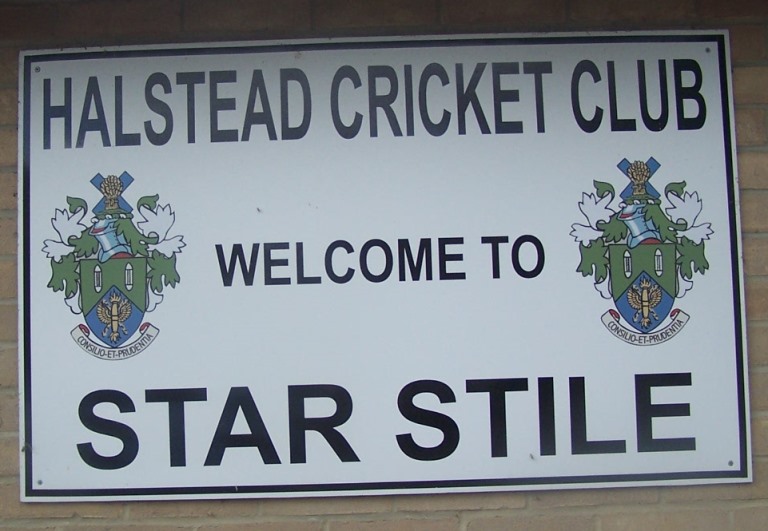
Halstead Cricket Club was founded in 1885.
After the normal warm-up for the Australians, the English players posed for their team photos and then a group photo with the Aussies.
After new Australian players Robin Court and Graeme McIlwain received their baggy green caps, the Australians then had their own team photo.
 Both teams then sang their national anthem.
The Australians won the toss and elected to field and after 50 overs England had made 7 for 237. Colin Cooke had 4 for 33 off his 10 overs supported by Rex Bennett with 2 for 19 off 8 overs. Robin bowled 8 overs - no wickets for 36 runs but the scoring of runs slowed when he was bowling.
 The Australians then batted but could only make 8 for 166 allowing England to win by 71 runs, a disappointing result. England therefore maintained their winning run against Australia.
A large  crowd came to watch the game including many families supporting the English and sometimes the Australian players.

Next day we were back at Halstead for a game against Essex.

Australia batted first and made 6 for 238 off 44 overs when rain finished the innings. The second innings was delayed and the Australians worked to complete the 20 overs to have an official match. The final score, when players were forced to leave the field, was 4 for 97 off 33 overs. Robin and Brian Scott once again slowed down the run rate while picking up a wicket each. Greg Quinn contributed 2 wickets for 37 runs. Australian won on run rate.
Halstead has won prizes for its floral displays and a number of examples were near the cricket ground.