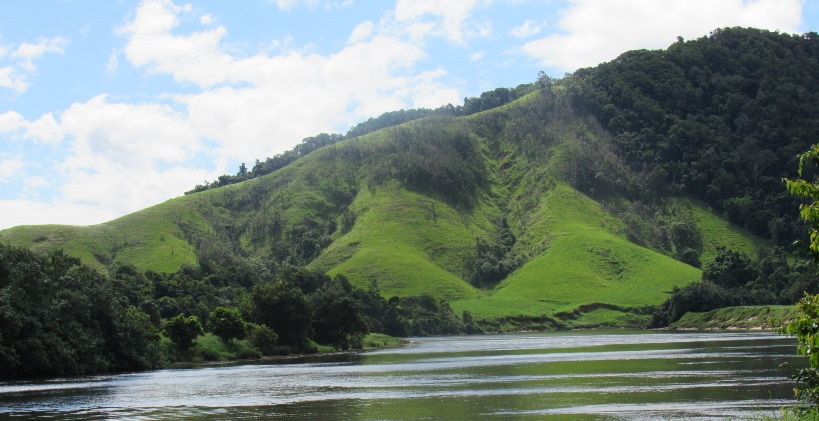
Whever we go to Port Douglas we also visit Mossman Gorge, approximately 20 kilometres north west of Port Douglas.
Firstly you drive to the Mossman Gorge Visitor Centre from where you take a shuttle bus to the gorge.
It is then a short walk to a suspension bridge where there is a good view of the water tumbing over the rocks, provided that not too many people, primarily children, are also crossing the bridge.
On the other side is a long circuitous walk through the rainforest.
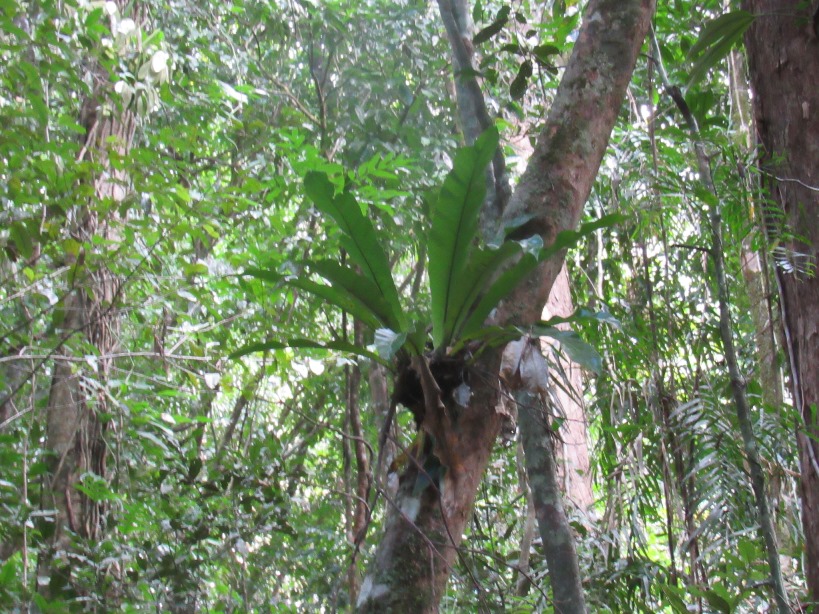
A wide variety of vegetation can be seen on the walk.
Creeping plants grow on trees.
Moss and lichens grow on rocks, trees and old logs.
Fungi can also grows on trees and logs.
Plants grow on other plants.
Trees develop a variety of root systems.
Large vines also entwine themselves around the trunks of trees.
A great place to explore.
We had lunch at the Mayi Cafe at the Mossman Gorge Visitor Centre where I had a delicious roast vegetable sandwich. We did confuse the staff, however, when I asked for a cup of hot water!
After lunch we looked at art works in the gallery and purchased items from gift shop before returning to Port Douglas.
Sunday, July 31, 2016
Port Douglas - Mossman Gorge
Port Douglas - Daintree Village
A short drive north from Port Douglas is Daintree Village situated on the Daintree River.
This is another beautiful location in Far North Queensland, even when it is raining.
The crocodiles also like this area so warning signs are prominently displayed.
On our last visit to Daintree Village we took one of the tours exploring the river and looking for crocodiles.
Once the edge of the Daintree Rainforest before timber cutters removed many of the trees, this is now a farming area.
The cattle grazing in the paddocks are accompanied by cattle egrets.
The slope from the town to the river is steep as can be shown by these flood water markers.
On this trip we made two visits to Daintree Village. The first was in the morning on a showery day and the village was very quiet. The following week we visited early in the afternoon and there were more people around.
The Timber Gallery has displays relating to the history of the timber industry in the area as well as items for sale, however we had the impression that the stock was diminishing in quantity.
The Big Barramundi is one of the features of the village.
When visiting Daintree Village, a place to visit is Eliza's Gallery situated in a house opposite the Big Barramundi. On a previous visit we purchased some pottery but this time purchased glass jewellery made on the premises.
We had lunch at the Daintree Village Hotel, at the river end of Stewart Street, where we shared a prawn and avocado roll. We were about to sit down at a table overlooking a row of bushes with brightly coloured flowers when a Ulysses butterfly appeared. On all our visits to Far North Queensland this was the first time I had seen one in the wild.
These butterflies fly very quickly and are difficult to photograph and when they fold up their wings they appear brown.
The Ulysses butterfy was soon joined by a Cairns Birdwing - bright green wings when flying but green, yellow and brown wings when they are folded.
Later in the day, across the road, we also saw a large butterfly with brown wings with white markings.
While we were trying to photograph butterflies we met a man who was trying to photograph this sunbird which was also exploring the bushes and nearby trees. It didn't really want to stay still for photographs either.
Watching these butterflies and the sunbird was definitely one of the highlights of the holiday.
Port Douglas - Four Mile Beach
A short walk down Macrossan Street is Four Mile Beach.
This long stretch of firm sand is ideal for walking and exploring. In July 1932 Charles Kingsford Smith landed his plane, the Southern Cross, on the beach.
People walk, run or cycle along the sand or just sit and enjoy the sunshine.
At the Macrossan Street end of the beach life savers patrol a section of the beach for swimming.
Beach cricket, beach soccer, beach volley ball are only some of the games played on this stretch of sand.
At the far end of the beach, kites are sometimes flown.
Small sailing boats can be launched from the beach
or can be seen sailing by.
Coconut palms border the beach and coconuts can frequently be found near the palms or at the water line.
Not so many people frequent the far end of the beach but this is also a special place.
When the tide is out the beach seems to double in size.
Shells and coral can often be found on the sand at low tide.
Around the curve at the far end of the beach are mangrove swamps to admire from afar. Crocodiles have been seen in this area.
One afternoon we discovered this kookaburra on the sand.
On another occasion we found this sand crocodile.
When the tide goes out crabs create these patterns in the sand.
Photographing the small crabs, however, can be a challenge.
Sunset was approaching when this photograph was taken.
Four Mile Beach is a beautiful place to visit and explore.
Port Douglas - Lookouts
There are two lookouts providing a view of Four Mile Beach.
A set of steps from Jalun Park, accessed via the Macrossan Street end of the beach, leads to a lookout providing a good view of Four Mile Beach.
We then walked along Murphy Street, which runs parallel to Macrossan Street, until we came to Island Point Road. This road is a steep hill which leads to another lookout higher than the the one accessed from the beach.
Cars can also drive up to this Flagstaff Hill lookout.
Towards the bottom of the walk down the hill provided this view over the inlet.
Thursday, March 17, 2016
Adelaide - March 2016
In 2016 the annual match between Victoria and South Australia over 60s and 0ver 70s cricket teams was played in Adelaide.
Back Row from left: David Cordy, Trevor Selby, Rex Bennett, Wayne
Stokes, Gordon Cowling.
Front row from left: Kevin Lanigan, Lindsay Fisher, Ian Gibson, Ron Lovell, Robin Court, Gary Ralph.
We left Melbourne on the Saturday morning to fly to Adelaide, arriving shortly after one o'clock. At Tullamarine we had met Peter (from the over 70s team) and Lorraine and agreed to share a taxi to the hotel. Arriving in Adelaide we discovered that Trevor had also been on the plane so three cricket bags and other assorted luggage plus five passengers piled into a maxi-cab to travel the short distance to the Tonsley Hotel at Clovelly Park.
Most of the members of the two Victorian teams stayed at this hotel though some had booked into a hotel at Glenelg. The hotel is situated on South Road, a major road leading towards Adelaide. Robin and I went for a walk in the afternoon to explore the neighbourhood. Clovelly Park appears to be a mixture of residential and industrial areas. South Road is lined with large retail establishments selling cars, car parts, furniture etc. There are also a variety of factories near the hotel. On the Sunday morning I went for a walk in the area behind the hotel and away from the main road there are large residential areas, community halls and parks.
The area was originally primarily vineyards and almond groves until after the Second World War when residential and industrial development was introduced. The former Chrysler Australia car plant was opened in this area in 1964. The bar in the Tonsley Hotel is the Chrysler Bar. Another reminder of the history of the area is the series of photographs on the restaurant walls showing the vineyards that once existed until the land was sold and the hotel built in the 1990s. Wattiparinga, the original house on the property, still stands behind the hotel, surrounded by factories.
On the Saturday evening members of both the over 60s and over 70s teams and their wives plus a number of members of the South Australian teams met for a Meet and Great session followed by an informal dinner at the hotel.
On the Sunday morning we travelled to the sports grounds at Brighton, a suburb a short distance from the hotel. A junior cricket grand final was played on the main ground in the morning so the matches were not scheduled to commence until 12 noon. Once the junior game had finished over 60s players inspected their pitch while the over 70s players set off to play on the adjoining ground.
Meanwhile some players began their warm-up exercises.
In the over 60s match a final team discussion was held before the game began.
Victoria fielded first and in their 45 overs the South Australian team could only manage a score of 9 for 77. Once again the bowling from the Victorians was excellent. The grass was very lush - a sign near one of the parks stated that bore water was used for watering - resulting in a slow outfield making it difficult to score boundaries.
Ron Lovell (3 for 14) and Gordon Cowling opened the bowling followed by Robin Court (2 for 5), Rex Bennett (2 for 15) and Lindsay Fisher (2 for 6). The maximum number of overs a bowler was allowed to bowl was 8. Consequently there were some very happy Victorian players at lunch.
After lunch the Victorians discovered how difficult it was to bat on that ground as the wickets of the batsmen began to fall. It was left to the final pair of Trevor Selby and Robin Court to score the winning runs. The final score was 9 for 78 with only a couple of overs to go. Trevor Selby (24 not out - including a four to win the match) and Kevin Lanigan (21) were the most successful Victorian batsmen. A narrow victory to Victoria in an unusual game.
In the over 70s match Victoria batted first and made 9 for 93. South Australia finished with 6 for 129 in 36 overs.
In the evening members of the four teams with partners met for dinner at Club Marion.
We returned to Melbourne the next day after a busy weekend in South Australia.
![]() |
| Victorian over 60s cricket team |
Front row from left: Kevin Lanigan, Lindsay Fisher, Ian Gibson, Ron Lovell, Robin Court, Gary Ralph.
We left Melbourne on the Saturday morning to fly to Adelaide, arriving shortly after one o'clock. At Tullamarine we had met Peter (from the over 70s team) and Lorraine and agreed to share a taxi to the hotel. Arriving in Adelaide we discovered that Trevor had also been on the plane so three cricket bags and other assorted luggage plus five passengers piled into a maxi-cab to travel the short distance to the Tonsley Hotel at Clovelly Park.
Most of the members of the two Victorian teams stayed at this hotel though some had booked into a hotel at Glenelg. The hotel is situated on South Road, a major road leading towards Adelaide. Robin and I went for a walk in the afternoon to explore the neighbourhood. Clovelly Park appears to be a mixture of residential and industrial areas. South Road is lined with large retail establishments selling cars, car parts, furniture etc. There are also a variety of factories near the hotel. On the Sunday morning I went for a walk in the area behind the hotel and away from the main road there are large residential areas, community halls and parks.
| South Road, Clovelly Park - Google Maps |
![]() |
| Wattiparinga - now surrounded by factories |
On the Sunday morning we travelled to the sports grounds at Brighton, a suburb a short distance from the hotel. A junior cricket grand final was played on the main ground in the morning so the matches were not scheduled to commence until 12 noon. Once the junior game had finished over 60s players inspected their pitch while the over 70s players set off to play on the adjoining ground.
![]() |
| Ground inspection & over 70s players heading off to the far ground |
![]() |
| Rex and Robin |
Victoria fielded first and in their 45 overs the South Australian team could only manage a score of 9 for 77. Once again the bowling from the Victorians was excellent. The grass was very lush - a sign near one of the parks stated that bore water was used for watering - resulting in a slow outfield making it difficult to score boundaries.
![]() |
| Picturesque grounds at Brighton |
![]() |
| Robin coming in to bowl |
![]() |
| Victoria fielding in over 70s match |
In the evening members of the four teams with partners met for dinner at Club Marion.
We returned to Melbourne the next day after a busy weekend in South Australia.
Labels:
Adelaide,
Cricket Tour,
South Australia,
State Game
Subscribe to:
Posts (Atom)