Sunday, April 13, 2025

On the road to the Barossa Valley - road to Tanunda

We left Nhill at 9 am and stopped at Bordertown in South Australia for breakfast.

Approaching the border we saw signs alerting us to bins in which to place any fresh fruit or vegetables that were not allowed in South Australia. We did not notice any signs designating the border on the trip to South Australia though we did notice a Welcome to Victoria sign on the side of the road when we returned.

Bordertown is 20 kilometres west of the border between Victoria and South Australia. Like many of the towns in this area large silos are near the railway station.

We had breakfast at the Morning Loaf Bakery.
Robin had an egg and bacon roll for breakfast while I ate a ham croissant. This was another bakery / cafe with lots of character.
In this case, the former police station building was part of the interior of the bakery. The toilet block out the back of the bakery continued the prison theme.
Nearby was a park with a small lake.
Back in the car, we continued along the Western Highway to Murray Bridge where we went for a walk along the banks of the river.
A plaque commemorating when Captain Charles Sturt rowed a whale boat along the river in 1830 is on the river bank.
It was a hot day and the temperature had reached 40 degrees by 12.30 when we were at Murray Bridge. We then continued our journey to Tanunda in the Barossa Valley, arriving mid-afternoon.

Barossa Valley - Tanunda part one

 We arrived at Tanunda on the afternoon of 15 March. Our accommodation was the Wine Vine Hotel.

Many of the car parking spots at the hotel had vines growing at the side.
However the plant outside our door was definitely dead.

The Barossa Valley was named by Colonel William Light in 1837. Light had been a soldier during the Battle of Barossa in Spain in 1811.

The hotel was a short drive from the centre of the town. The name, 'Tanunda', is derived from the Aboriginal word for waterhole. Prussian immigrants started settling in the area from 1842. Initially there were two settlements with German names which were changed during the First World War. Eventually the two settlements joined to be known as Tanunda.

After we had settled into our room we decided to explore part of the town. At each end of the main shopping area is an arch welcoming you to Tanunda and carrying the name of a major wine company in the area. Seppelt is the name on the other side of this arch. At the other end of the town is a similar arch carrying the name of Jacob's Creek.

Our first stop was the information centre where we collected pamphlets and ideas on places to visit when there was no cricket.

A small public library also operates in this space.

We had a short walk exploring the main street but then decided to explore the area properly when the temperature was not 43 degree. We did stop at Beans and Cream to enjoy an ice cream though it was a challenge to eat it before it melted.

That evening, Robin went back into Tanunda and purchased half a chicken, chips and coleslaw from Tanunda Chicken and Seafood.
On another occasion we enjoyed delicious butterfish, with chips,coleslaw and potato salad from the same cafe.
During the next week we had lots of opportunity to explore Tanunda.

 With its Prussian / German origins it is not surprising that there are many Lutheran churches in region.

In Murray Street is located St Paul's Lutheran Church.

Tabor Lutheran Church

Langmeil Lutheran Church.
Around the corner in Jane Street is St John's Lutheran Church.

One of the features that you notice when exploring Tanunda is how the older buildings have been preserved and repurposed.

The Tanunda Institute was established in 1869 and this building was constructed in 1879. It originally consisted of a hall, meeting room and library. A major function was to promote the learning of English among the German speakers.In 1920 the building was purchased by the Barossa News and printed newspapers until 1987. Since then the building has been used as offices.

Many examples of the town's history can be viewed as you walk down Murray Street.

View of part of a former flour mill.

Barossa Valley - Tanunda part two


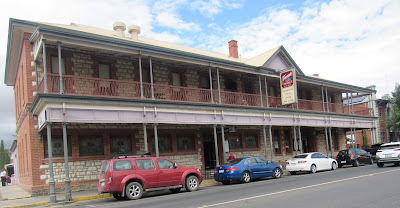
The original Tanunda Hotel was built between 1845-1846 and was granted a licence in 1847. The hotel was rebuilt between 1905-1910. Additions to the hotel in 1945 caused it to almost double in size. We enjoyed two meals at the hotel while we were in Tanunda.
Across the road from the hotel is Four Seasons of Nosh, a cafe at the end of the old flour mill building. We enjoyed lunch there one day. I had a feta and pumpkin tart while Robin enjoyed a poached egg with salmon. However, when we returned another day they were closing early.
Many older shops line Murray Street.
Another cafe in Tanunda is Hustle.
Robin had a birthday when we were in Tanunda so we chose to have dinner that night at a restaurant named Knead. We began the meal with a serve of Sourdough with Parmesan oil. Robin then had rigatoni duck ragu while I had I had papardelle with mushrooms. To end the meal Robin had banana cake with chocolate sorbet, salted caramel and roasted macadamias while I had crème brulee with pistachio biscotti. We enjoyed this special meal.
In another converted stone building is The Raven's Parlour bookstore which has a large collection of books for sale. We purchased a book on the history of the Barossa Valley.
The Barossa Museum is open two days a week - Monday and Friday afternoons.
The building was formerly the post office and telegraph office built in 1866. The building has been used as a museum since 1972.
The Barossa Regional Gallery has been housed in the former Tanunda Soldiers Memorial Hall since 2003. Additions are about to be made to the building to expand the size of the gallery and allow for art and craft workshops.
A major feature of the gallery is the restored Hill & Son Grand Organ built in 1877 in London and installed in the Adelaide Town Hall. In 1998 it was decided that the organ would be installed in the memorial hall and the restoration project taking fifteen years was undertaken.
Photographs of soldiers from the region who died during war plus the Tanunda Roll of Honour are displayed on one wall.
A new updated version of The Barossa Cookery Book has been recently complied and in the galley was a display depicting some of the recipes in the book. A selection of the recipes from the original book have been used along with information about the lives of the women who submitted the chosen recipes.
The book therefore provides a social history of the region as well as a selection of updated recipes ideal for meals today.
Our final team get together was a dinner at The Clubhouse. It was a friendly way to end the cricket carnival.
Back in the main street is a shop selling a range of old-style sweets. We had to purchase a selection for the family.
In the main street is a small park with a rotunda.
On our last day in Tanunda we returned to Beans and Cream for lunch. After visiting the Art Gallery we returned for an ice cream.

Barossa Valley - Cricket

Each year in March a veterans cricket carnival is held in the Barossa Valley with eight teams taking part. This year Arthur Pritchard organised a team - the SilverAshes3Nil - to take part in the carnival.

In March 2018 the England over 70s team toured Australia. They played games in a number of states and were also to play five ODIs against the Australian team. Australia won the ODI played in South Australia and in Geelong. The next two ODIs were to be played on the Sunshine Coast but rain intervened. The final ODI played in Brisbane was won by the Australian team. Australia therefore won the Silver Ashes 3 Nil.

Invitations were made to members of that Australian team to play in the Barossa Valley carnival as a seven year reunion. Robin had been a stand-by player for 2018 team so was also invited to play. Later in 2018 Robin was in the Australian team that toured England along with a number of members of the team that played in Australia earlier in the year. As the 2025 carnival approached a number of players had to withdraw due to health issues so the final team included a number of extra players from South Australia who kindly boosted our numbers.

Members of the team playing in the Barossa Valley

Robin at Sandy Creek

Two games were played at Angaston on 17 March and 21 March.

The entrance to the Angaston Recreational Park where the cricket ground is located. One of the pillars is a memorial to soldiers who served during the Second World War.
Outside the entrance to the park were several colourful rose gardens.
It was a an attractive ground for playing cricket.
The Angas Pavilion was constructed with money donated by the Angas family in 1903.
Our first game was against the Mayor's Eleven who batted first and made 100 runs. The bowling of our team was excellent with Ron taking three wickets. Robin ended up bowling ten overs during the match - 0 wickets for 28 runs. Unfortunately our team could only make 98 runs in a very close game. Robin and Greg had a good last wicket stand until Robin was caught after scoring 22 runs.

Our fourth game was also at Angaston, this time against the Eastern Reds. Our team batted first, making 102 runs. Robin made six runs. The Eastern Reds won the game in the 34th over - 2 wickets for 103 runs. Robin bowled his six overs, 1 maiden, 0 for 15 runs.

Game two was at Curdatta Park, Sandy Creek, south of Tanunda. The game was against the ACT Galaxies. It was a pleasant sunny day with temperatures in the mid 20s.
The cricketers had an additional audience watching the game.
The cricket ground at Sandy Creek was another pretty ground with lots of ibis plus a heron or two sharing the ground.
Our team batted first and made 84 runs. ACT was 1 for 85 in the twenty-fifth over. Robin bowled 3 overs - 1 wicket for 7 runs.

Game three was to be played at Tanunda against the Australian Cricket Society, however rain during the morning prevented play.
The ground has new function rooms as well as older grandstand and rooms. The carnival dinner was held in the function rooms at Tanunda Cricket Ground.